
STEVE HUANG


Soft Robotic Mechanism
FLEXIBILITY
Soft Robotics are highly flexible and can allow for a wide range of motion without sacrificing durability
MOTION
They produce a smooth motion that mimics plant function and improves the movement of products
TECHNOLOGY INTEGRATION
There is possibility to integrate computer controls, which can improve automation and application

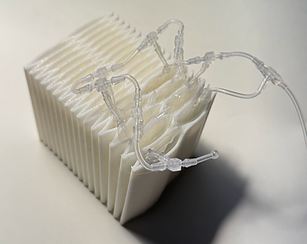
Honeycomb Mechanism

To maximize flexibility, the honeycomb walls are only 1.5mm thick, with 2x4mm rectangles on all sharp corners


Contracted
Expanded


(Hover to See Expansion)
INPUT
Sensor-- light sensing, touch sensing, switch-control-- inputs electrical signal to actuator (pneumatic or hydro pump)
PROCESSING
Actuator induces hydro or air pressure into the “flexible pillows” via thin silicone tubes
OUTPUT
Honeycomb structure expands through the enlarged pillows, inducingmotion and pushes onto movement interface
System
Diagram

Contracted


Expanded


SPECS
Honeycomb Structure (Contracted):
L: 3.5” W: 2” H: 2.375”
Wall Thickness: 1.5mm
Material: TPU, 2-Wall
Pneumatic System:
Tube: Silicone, 1mm ID x 2mm OD, 4m used
3-Way Joint: Silicone, 1/16”, 32 used
Air Pillow: PA/PE, 1” x 2.5”, 32 used
Adhesive: Hot Glue
Complete Prototype:
Contracted: L: 4” W: 3” H: 3.5” (Rough Estimate)
Lack of air pressure:
Requirement of high-pressure air pump which was not met in this prototype
Air leakage of the pillows:
There are observed leakage on the air pillows, which was unable to be resolved
Reducing the number of air pillows allowed the cells to expand more
Limitations of This Prototype
(Hover to View)